Tools & Equipment · Electrical Test & Measurement
KAIWEETS KT301P Review: Circuit Breaker Finder and GFCI Outlet Tester
How the KAIWEETS KT301P traces a breaker, checks outlet wiring and GFCI, and where a finder must not be treated as proof a circuit is safe to touch.
Affiliate disclosure: PetecGlobalMarket is a participant in the Amazon Associates Program. If you buy through the product link in this review, I may earn a commission at no extra cost to you. This article is an unpublished draft for editorial review.
Electrical safety warning: A circuit breaker finder, outlet tester, GFCI test, or non-contact voltage alert does not by itself prove a wire, box, or device is safe to touch. False readings happen with shared neutrals, multi-wire branches, damaged wiring, low batteries, and incorrect use. Turn power off at the breaker you identify, then verify the circuit is de-energized with a proper tester before you touch conductors. If you are not qualified to work in a panel, stop and call a licensed electrician.
Introduction
Unlabeled breaker panels turn a five-minute outlet repair into a guessing game. The KAIWEETS KT301P is sold as a circuit breaker finder with an LCD, a GFCI outlet tester, non-contact voltage detection, a flashlight, and a small adapter kit in a case. This review explains what those functions are for, using the manufacturer’s published parameters, and where the tool stops.
Product Overview
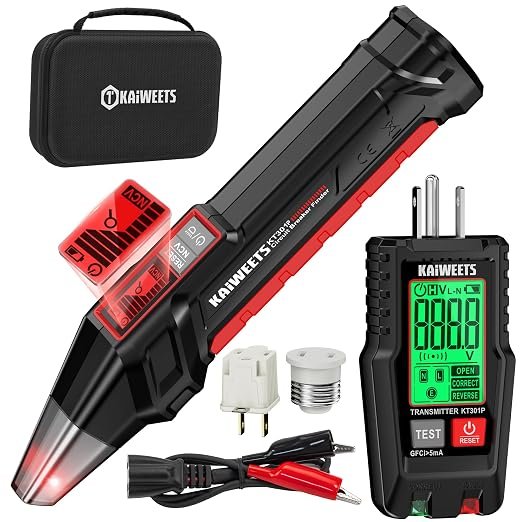
KAIWEETS describes the KT301P as a two-piece kit: a transmitter that plugs into an outlet and doubles as a GFCI and wiring tester, and a receiver you scan across the breaker panel. The complete accessory kit adds a carrying case, a 3-prong to 2-prong adapter, a light-socket adapter, and an alligator-clip adapter, plus four 1.5V alkaline batteries. A basic kit on the same product family omits the three adapters. Confirm which kit your Amazon listing actually ships.
The manufacturer’s operating range is 90 to 120V AC, 50/60 Hz. This is a residential branch-circuit tool, not a 240V or three-phase tracer. For other electrical test tools already on this site, see the Fluke and Fieldpiece reviews in Electrical Test & Measurement — those are meters and testers, not substitutes for a breaker finder.
Key Features
Breaker identification
Plug the transmitter into the outlet on the circuit you care about, then scan the panel with the receiver. Signal strength on the LCD is how the kit points you at a breaker.
Backlit LCD
KAIWEETS lists a display for real-time voltage (about 30–150V), outlet wiring status, and signal strength, including in a dim panel.
GFCI outlet test
The transmitter can run a GFCI trip test and, per the manufacturer, report seven common wiring faults with LED and LCD feedback. Auto-hold keeps the last outlet result after unplugging.
NCV on the receiver
Non-contact voltage detection is for spotting a live field near the sensor. It is not a substitute for a contact test before you touch a conductor.
Flashlight
The kit includes a flashlight function for panels and closets with poor light. The supplied product photo shows the receiver tip area used during tracing.
Case and adapters
Complete-kit listings include a case plus 3-to-2 prong, light-socket, and alligator-clip adapters so you are not limited to a standard grounded receptacle.
Specifications
Parameters are from KAIWEETS’ KT301P product page. The LCD marketing range (30–150V) and the phase-measurement line (30–120V) are both published; they are not identical, so both are shown.
| Model | KT301P |
|---|---|
| Type | Circuit breaker finder with GFCI outlet tester |
| Operating voltage | 90–120V AC, 50/60 Hz (manufacturer parameters) |
| Voltage display range | LCD shows about 30–150V; phase measurement listed as 30–120V / 45–65 Hz |
| Display | Backlit LCD for voltage, wiring status, and signal strength |
| GFCI test | Transmitter includes GFCI trip test |
| Outlet wiring | Manufacturer states diagnosis of 7 common wiring faults |
| NCV | Non-contact voltage test on the receiver |
| Flashlight | Included on the kit (product name and supplied photo) |
| Batteries | 4×1.5V alkaline included (manufacturer package list) |
| Accessories (complete kit) | Carrying case, 3-prong to 2-prong adapter, light-socket adapter, alligator-clip adapter |
| Operating temperature | 32°F to 122°F (0°C to 50°C) |
| Altitude | Up to 6,562 ft (2,000 m) |
Performance
Used as directed, the finder is meant to shorten the search for the breaker that feeds a given 120V outlet, lamp socket, or clipped conductor. You establish a signal with the transmitter, scan the panel, and use the receiver’s indication to narrow the breaker. A second pass after you think you have the right breaker is normal practice with this class of tool, because adjacent breakers can couple signal.
The outlet-tester side is a separate job: wiring indications and a GFCI trip test while the transmitter is plugged into a live, compatible receptacle. A successful GFCI trip shows that the test button path opened the device under those conditions. It does not certify the GFCI for code, measure trip time, or prove every downstream outlet is protected.
NCV and the flashlight are convenience functions on the receiver. NCV can warn you that a field is present. It can also miss a live conductor if the sensor is not close enough, the battery is weak, or the wiring is shielded. Absence of an NCV alert is not proof of a dead circuit.
Durability and Build Quality
The KT301P is a handheld plastic test kit with a zip case, not a meter rated for industrial abuse. KAIWEETS lists an operating temperature of 32°F to 122°F, storage down to −4°F, humidity under 90% non-condensing, and a maximum operating altitude of 6,562 feet. Those are environmental limits, not a drop rating. No CAT safety category was confirmed on the parameter table checked for this draft — flag that before publishing if you want a CAT figure in the article.
The four alkaline cells are listed as included. Replace them when the display or NCV becomes unreliable. A weak battery is a common reason tracer results wander.
Pros and Cons
- Pros: Combines breaker tracing, outlet wiring indication, and GFCI trip test in one kit
- Pros: Backlit LCD for voltage and signal strength
- Pros: NCV and flashlight on the receiver for panel work
- Pros: Complete kit lists a case and three adapters, plus batteries
- Pros: Operating range is clearly stated as 90–120V AC
- Cons: Not a 240V, three-phase, or industrial circuit tracer
- Cons: Does not prove a circuit is de-energized or safe to touch
- Cons: GFCI test is not a full code certification or trip-time measurement
- Cons: CAT rating was not confirmed in the parameter table checked
- Cons: Basic vs complete accessory kits differ — confirm the Amazon contents
- Cons: Competitor feature cells in the comparison still need a sheet check
Why Buy the KAIWEETS KT301P?
Buy the KT301P if you regularly need to match a 120V outlet or fixture to a breaker and you also want a plug-in check for wiring indications and GFCI trip on standard receptacles. The LCD, adapters, and case are the practical reasons to pick this kit over a breaker finder that only beeps. You are not buying a license to open boxes without a second, proper dead-circuit test.
Comparison Table
Klein Tools ET310 is a widely sold transmitter-and-receiver breaker finder in the same general job. KAIWEETS KT302P is the maker’s other finder kit. Cells that were not verified on those current spec sheets are marked for confirmation rather than invented.
How the KAIWEETS KT301P compares with other circuit breaker finders
| Spec | KAIWEETS KT301P | Klein Tools ET310 | KAIWEETS KT302P |
|---|---|---|---|
| Type | Breaker finder + GFCI outlet tester | Transmitter/receiver breaker finder | Breaker finder (separate KAIWEETS model) |
| Listed working range | 90–120V AC branch circuits | Typically 90–120V AC — confirm current Klein sheet | Confirm on the KT302P listing |
| LCD voltage readout | Yes, backlit | Not the same LCD feature set — confirm | Confirm on the KT302P listing |
| GFCI outlet test | Yes, on the transmitter | Confirm whether the current ET310 kit includes GFCI test | Confirm on the KT302P listing |
| NCV | Yes, on the receiver | Confirm on the current ET310 listing | Confirm on the KT302P listing |
| Adapters and case | Case plus three adapters on the complete kit | Kit contents vary — confirm | Confirm on the KT302P listing |
| Best for | Homeowners tracing 120V breakers and checking outlets | Shops already standardized on Klein tracers | Buyers comparing KAIWEETS finder kits |
Comparison cells marked for confirmation were not invented. No prices or ratings are shown.
Who Should Buy It?
Homeowners and maintenance staff who work on 120V branch circuits, have a poorly labeled panel, and will still verify power is off before touching wires. It is a reasonable kit if you want outlet and GFCI checks in the same case as the tracer.
Limitations and Electrical Safety Considerations
- Do not use the KT301P outside its listed 90–120V AC range. It is not the tool for electric-range, dryer, or other 240V circuits unless a qualified person confirms a safe, supported test method — this review does not provide one.
- Identifying a breaker is not the same as proving the circuit is dead. After you switch the breaker off, test the conductors with an appropriate voltage tester before contact.
- NCV “no beep” is not an all-clear. Sensor position, battery condition, and wiring method all affect non-contact detection.
- A GFCI that trips during the test still needs to be reset and understood. A GFCI that does not trip needs investigation. Neither result means the rest of the circuit is safe to touch.
- Outlet wiring lights can be wrong on open neutrals, bootleg grounds, and multi-wire branches. Treat unexpected indications as a stop sign, not as a DIY challenge.
- If you are unsure, leave the panel cover on and hire a licensed electrician.
Frequently Asked Questions
Q.What does the KAIWEETS KT301P do?
A.It is a circuit breaker finder kit. The transmitter plugs into a 90–120V outlet and can also test GFCI and show wiring status. The receiver scans the panel and includes NCV and a flashlight.
Q.Does it include a case and adapters?
A.The complete accessory kit lists a carrying case, a 3-prong to 2-prong adapter, a light-socket adapter, and an alligator-clip adapter, plus four 1.5V batteries. A basic kit omits the three adapters. Confirm the Amazon page.
Q.What voltage does the LCD show?
A.KAIWEETS says the screen displays real-time voltage in a roughly 30–150V window, and lists phase voltage measurement as 30–120V at 45–65 Hz. Operating voltage for the finder is 90–120V AC.
Q.Can I trust it to tell me a wire is safe to touch?
A.No. Use it to help identify a breaker and to get outlet indications. Then turn that breaker off and verify the circuit is de-energized with a proper tester. This tool alone does not prove a circuit is safe to touch.
Q.Does the GFCI test replace an electrician’s test?
A.No. The built-in GFCI trip test is a functional check of that receptacle’s test path. It is not a certification, a trip-time measurement, or a guarantee that downstream devices are protected.
Q.Will it find a 240V breaker?
A.The published operating voltage is 90–120V AC. Do not assume it traces 240V appliances. That use is outside the verified range for this review.
Final Verdict
The KAIWEETS KT301P is a practical 120V breaker-finder kit for people who also want an LCD, a GFCI outlet test, NCV, a flashlight, and a few adapters in one case. Those functions match what the manufacturer publishes, within 90–120V AC branch circuits. It is not a safety certificate. Identify the breaker, switch it off, and verify the circuit is dead before you touch anything. If the work is beyond a clearly labeled 120V receptacle check, call an electrician. Confirm complete-kit contents on the live Amazon listing before you buy.
Ready to check current pricing?
As an Amazon Associate I earn from qualifying purchases.
Check Price on Amazon