Tools & Equipment · Power Tools
iCrimp Ratchet Wire Crimping Tool Set Review: 5 Interchangeable Jaws Explained
What the iCrimp IWS-30J ratchet wire crimping tool set actually does: five interchangeable jaws, advertised AWG 20–2 range, the included stripper, insulated vs non-insulated terminals, and who the kit suits.
Affiliate disclosure: PetecGlobalMarket is a participant in the Amazon Associates Program. If you buy through the product link in this review, I may earn a commission at no extra cost to you.
Introduction
A box of electrical terminals can contain several problems disguised as one. A vinyl-insulated ring terminal, a bare tab and a large cable lug may all connect wire, but they do not necessarily need the same crimp. That is the appeal of the iCrimp ratchet wire crimping tool set: instead of buying a separate handle for every profile, you change jaws on one ratcheting frame.
The linked product is the iCrimp Ratchet Wire Crimping Tool Set with 5 Interchangeable Jaws for Insulated and Non-Insulated Terminals, AWG 20-2, with wire stripper included. Here is what that description means in practical terms—and what it does not promise. We have not personally or independently tested the kit; this review draws on the linked Amazon listing, an iCrimp manufacturer product page and the owner-supplied image.
Product Overview
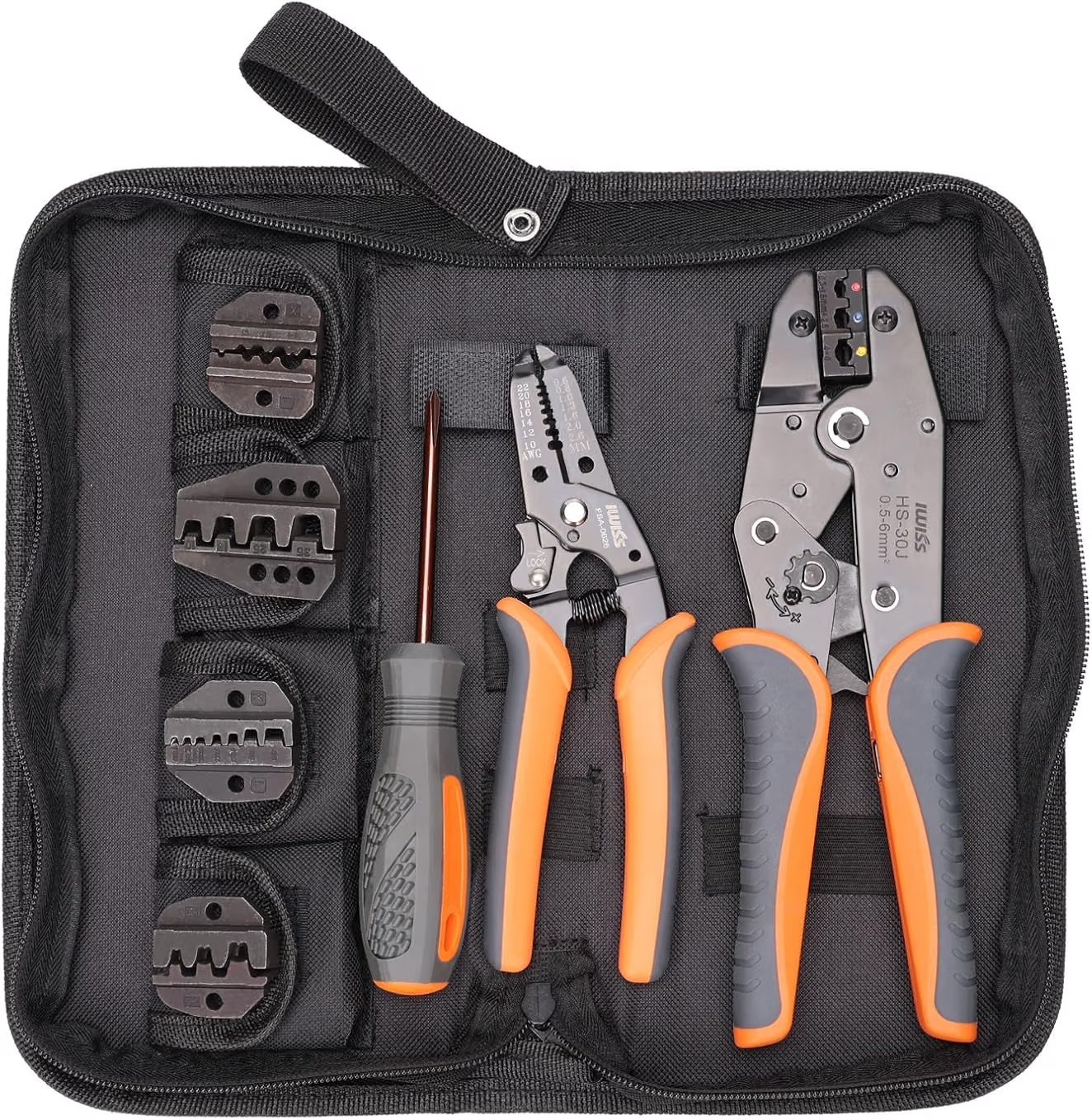
Amazon identifies the selected variant as the IWS-30J Terminal Tool Set and describes one ratcheting frame, five jaws, a wire stripper and a cross-head screwdriver. The image shows an IWISS-marked crimper, a separate stripper, driver, interchangeable dies and a zippered case. iCrimp is associated with IWISS in the brand information on the listing. Confirm the selected variant because a similarly named heat-shrink set and a separate six-jaw quick-change kit are also sold.
The headline range is AWG 20–2 across the advertised set, not a promise that every jaw handles every size or every terminal. Individual die profiles and cavities determine the actual combination. The manufacturer describes the set in metric cross-sections of 0.5–35 mm²; conversion and terminal design are not interchangeable shortcuts for the printed die chart. Consult the instructions and connector maker before selecting a cavity.
Key Features
Five interchangeable jaws
Different die shapes compress different terminal barrels. The listing identifies applications including insulated terminals, non-insulated terminals, and non-insulated tabs and receptacles. Five jaws give the frame more potential applications than a single-purpose tool, but the number of pieces does not establish compatibility with every connector family. Check the actual markings and documentation for the exact die, profile and size; the available listing does not give a sufficiently clear, complete five-die mapping to safely reproduce one here.
An open-barrel contact may need separate formations around the conductor and insulation; a closed insulated barrel has a different geometry. A die intended to fold one should not be forced onto the other just because the gauge looks similar. Specialty contacts, coaxial connectors, solar plugs and proprietary terminals may require a different tool entirely.
Ratchet mechanism and jaw changes
The listing describes a precision full-cycle ratchet. In use, a ratcheting frame is designed to hold a terminal while the handles progress through a complete squeeze. That can help with repeatability, although correct positioning remains the user’s responsibility. The included screwdriver supports die changes; follow the supplied instructions to remove, orient, fasten and inspect the jaws. Do not assume this screw-mounted set has the toolless quick-change mechanism used by some other kits.
Switching dies takes more attention than picking up a second dedicated crimper. On a workbench, that trade-off may be worthwhile; on a ladder or in a cramped panel, small screws and loose jaws can be inconvenient. Keep the work area clear, use the proper driver and ensure both die pieces are secured and aligned before making a sample crimp.
Wire stripper and storage
The listing describes the separate spring-loaded wire stripper/cutter as having stripping holes for AWG 20–10. That is narrower than the crimping kit’s advertised overall range: a conductor outside the stripper’s stated range needs another appropriate stripper. The case helps keep components together, but confirm contents and replacements with the seller if a missing die would stop your work.
Detailed Specifications
| Specification | Listing or verified qualification |
|---|---|
| Product / selected variant | iCrimp IWS-30J Terminal Tool Set |
| Advertised kit range | AWG 20–2 across the kit; range is die- and terminal-specific |
| Manufacturer description | 0.5–35 mm² for the kit; check individual dies and terminals |
| Crimper | Manual full-cycle ratchet frame, per listing |
| Interchangeable jaws | Five, per selected Amazon listing; exact profile-to-size mapping requires kit chart |
| Stripper | Separate stripper/cutter; listing states AWG 20–10 stripping |
| Other pictured parts | Cross-head screwdriver and zippered storage case |
| Terminal families | Insulated and non-insulated terminals; tabs and receptacles as listed |
| Heat-shrink variant | Separately offered; do not assume this terminal-kit variant has the same die |
| Warranty | Not independently established for this exact selection |
Design and Build Quality
The supplied photograph shows a metal ratcheting frame with orange-and-gray handles, several individual metal die sets and a fabric case. A dedicated place for the stripper and screwdriver is helpful when the kit moves between a bench and a vehicle. Small retaining screws deserve particular attention: if one is misplaced, a die change may become impossible until the correct replacement is found.
The manufacturer describes steel construction, and the seller mentions rust prevention on the jaws. Those are descriptions, not measurements of alignment, calibration or long-term durability. We have not evaluated wear, grip comfort under sustained use, or whether the case withstands daily professional handling.
Performance and Ease of Use
The strongest case for the set is variety. If your repair uses several approved terminal types, one handle and a selection of dies can reduce the number of tools you carry. The trade-off is planning: find the die chart, choose the correct jaw and cavity, change the dies if necessary, and make a sample connection. A hurried switch to a die that merely looks close can produce a poor joint.
The full-cycle ratchet is designed to finish a stroke consistently, not to verify the wire’s position. Leave enough room to close the handles without twisting the terminal. If the frame or cable cannot be aligned, stop and find an approved tool that fits the work area. No pull-strength or speed result has been independently measured for this review.
Insulated vs. Non-Insulated Terminals
An insulated terminal has a sleeve surrounding the metal barrel. A compatible insulated-terminal die compresses the barrel through that covering while avoiding excessive sleeve damage. A bare or non-insulated terminal exposes its metal barrel, so its required crimp shape may be different and its finished connection may need suitable insulation or protective enclosure. Some open-barrel contacts have wings rather than a closed tube and need their own specific forming profile.
The connector manufacturer’s instructions take priority over the color of the sleeve or the nearest-looking nest. Confirm conductor material, terminal series, wire size and insertion depth. A listing’s broad description of insulated and non-insulated compatibility is not approval for all brands, open-barrel contacts or heat-shrink terminals.
A Practical Crimping Workflow
- Disconnect power, secure against reconnection and verify absence of voltage using appropriate equipment. Follow vehicle or equipment instructions where relevant.
- Identify the wire gauge and conductor material. Select a terminal approved for that conductor and intended environment.
- Consult the kit and connector charts to select the jaw profile and the specific cavity. Fit the jaws according to the instructions, securing both pieces and checking alignment.
- Strip only the length specified for the terminal. Use the supplied stripper only within its stated AWG 20–10 range; use another suitable tool for other sizes. Replace any nicked strands.
- Position the terminal and insert the wire to the specified depth. Keep the conductor and terminal aligned as you complete the ratchet cycle.
- Inspect the crimp and perform the terminal maker’s prescribed checks. A gentle tug can reveal a grossly loose wire but does not replace a specified pull-force test. Add insulation or heat shrink only when the terminal instructions require it.
Real-World Applications
A workshop might use different compatible terminals for a small control lead, a ring connection or a tab-and-receptacle repair. An automotive hobbyist may move between accessory wiring and non-insulated connections. In each example, the particular terminal’s documentation determines whether one of the included dies is suitable. The headline 2 AWG figure does not mean the included stripper handles 2 AWG, nor does it authorize the tool for every battery lug.
Electrical installations in buildings also have code, enclosure and approved-connector requirements. The tool alone cannot establish compliance. For mains work or a connection whose safe method is uncertain, consult a qualified electrician and follow local rules.
Pros and Cons
- Pros: Five interchangeable jaws provide more potential terminal profiles than a single-purpose crimper.
- Pros: Full-cycle ratchet, separate stripper and organized case make a useful starting workflow.
- Pros: The included screwdriver supports jaw changes without hunting for a driver.
- Cons: Each die has its own profile and size limits; AWG 20–2 is not universal coverage.
- Cons: The stripper is listed for AWG 20–10, not the full advertised crimping range.
- Cons: Screw-mounted die changes take time and require small parts; the heat-shrink variant is a different selection.
- Cons: We have not tested crimp quality, grip comfort or long-term durability.
Maintenance Guide
After use, wipe the frame and dies clean and remove wire fragments from the stripper. Inspect die faces for burrs, chips and corrosion, and check that retaining screws seat properly. A distorted or loose die can produce a bad crimp even when the ratchet cycles. Keep screws with their matching parts and do not force threads.
Keep the case and components dry. Inspect the stripper’s cutting edges and spring, and follow the manufacturer’s directions for cleaning or lubrication. Use a small amount of appropriate lubricant on pivots only if recommended, keeping it off connector surfaces. If alignment or ratchet action is suspect, stop and seek manufacturer guidance rather than improvising repairs.
Safety Tips
Never crimp energized conductors. Isolate and verify the circuit with an appropriately rated tester, and follow lockout procedures where required. Wear eye protection when cutting wire, keep hands clear of moving jaws and secure small terminals before squeezing. Handle grips are not evidence of an electrical insulation rating. Avoid using damaged dies or unapproved connectors in critical circuits.
Why Buy It? A Helpful Buying Guide
This kit makes sense when your projects actually use several of its documented profiles. Before purchasing, gather the terminal part numbers and wire sizes you expect to work with; ask for the complete die chart and compare each range with the terminal manufacturer’s tool requirements. Confirm the IWS-30J Terminal Tool Set selection, because the neighboring heat-shrink and six-jaw products are not interchangeable descriptions.
Also check whether the included stripper covers your conductors, whether replacement screws and dies are available, and whether the frame has enough clearance in your workspace. If a connector requires a manufacturer-specific tool or a formal pull test, budget for those requirements rather than treating any ratchet kit as an equivalent.
Comparison Table
| Product | Configuration described by listing | Main buying consideration |
|---|---|---|
| iCrimp IWS-30J Terminal Tool Set | Five jaws, ratchet frame, stripper and screwdriver | Check each die; stripper is advertised for 20–10 AWG |
| iCrimp quick-change six-jaw set B08DRCRRCQ | Six interchangeable jaws and stripper; quick-change design | Different kit; verify each profile and selected contents |
| Haisstronica 6PCS interchangeable terminal die set | Interchangeable terminal dies and storage | Check die selection and connector compatibility |
| Plustool 6PCS crimping tool set | Listing names dies for heat shrink, insulated, non-insulated and other terminals | Verify exact profiles, ranges and case contents |
The alternatives are distinct products, not a performance ranking. Product labels and bundle contents can change. A similar number of dies does not mean identical jaw shapes or coverage.
Who Should Buy This Product?
A DIYer or maintenance technician with several compatible terminal types and a place to change jaws may find the kit practical. It is especially useful when portability matters but dedicated tools for every occasional job would be excessive. Confirm the profile chart before ordering.
Who May Want to Consider Another Option?
Someone repeatedly crimping only one terminal may prefer a dedicated die with no parts to swap. A high-volume professional may need a manufacturer-specified, calibrated tool with documented inspection and service. If your main work is heat-shrink, open-barrel, solar or very large cable lugs, first confirm that the selected kit explicitly includes the exact approved die—or choose the tool specified for that connector.
Frequently Asked Questions
Does every jaw cover AWG 20–2?
No. That is the set’s advertised overall range. Every jaw and cavity has a specific purpose and range, which must match the connector and conductor.
Does the included stripper cover the entire range?
No. The listing describes its stripping holes as AWG 20–10. Use a suitable separate stripper for sizes outside that range.
Can it crimp all heat-shrink connectors?
No. Verify the selected variant and its die chart against the connector manufacturer’s requirements. The listing offers a separate heat-shrink tool set.
Are the jaws changed without tools?
The selected IWS-30J kit includes a screwdriver for its interchangeable jaws. Do not confuse it with the separately sold quick-change six-jaw set.
Is a pull on the wire enough to prove a crimp is safe?
A light tug can reveal a gross fault, but it cannot prove compliance. Follow the connector manufacturer’s inspection and test requirements, including measured pull tests when specified.
Final Verdict
The iCrimp IWS-30J kit is an appealing way to organize several wire-terminal tasks around a single ratcheting frame. Its five jaws, separate stripper and case are useful on paper, but versatility depends on the actual connector and die chart—not the kit’s broad headline gauge. For buyers who work with several documented terminal types and do not mind changing dies, it is worth a closer look. For one repeated terminal or a tightly specified professional application, a dedicated approved tool can be the simpler choice.
Sources checked: supplied Amazon IWS-30J listing, iCrimp’s IWS-30J product page and the alternate-product listings named above. Claims are attributed to those sources; no hands-on or independent performance test was performed.
Ready to check current pricing?
As an Amazon Associate I earn from qualifying purchases.
Check Price on Amazon