Tools & Equipment · Power Tools
AOBEN 3/8-Inch 12V Cordless Ratchet Wrench Review: Features, Battery Life and Maintenance
Review of the AOBEN 12V 3/8-inch cordless electric ratchet wrench set — two 2,000mAh batteries, charger, sockets and case — on features, battery care, maintenance, and safe use for DIYers and home mechanics.
Affiliate disclosure: PetecGlobalMarket is a participant in the Amazon Associates Program. If you buy through the product link in this review, I may earn a commission at no extra cost to you. This article is an unpublished draft for editorial review.
Introduction
Ask anyone who has removed a valve cover or reached behind an alternator and they will tell you the same thing: the fastener comes loose with a breaker bar, but the two inches of swing the ratchet needs to spin it out are simply not there. That is the gap a cordless ratchet fills. It is not a high-torque impact wrench; it is a powered hand that turns a fastener quickly once the hard part is done, so your wrist does not have to.
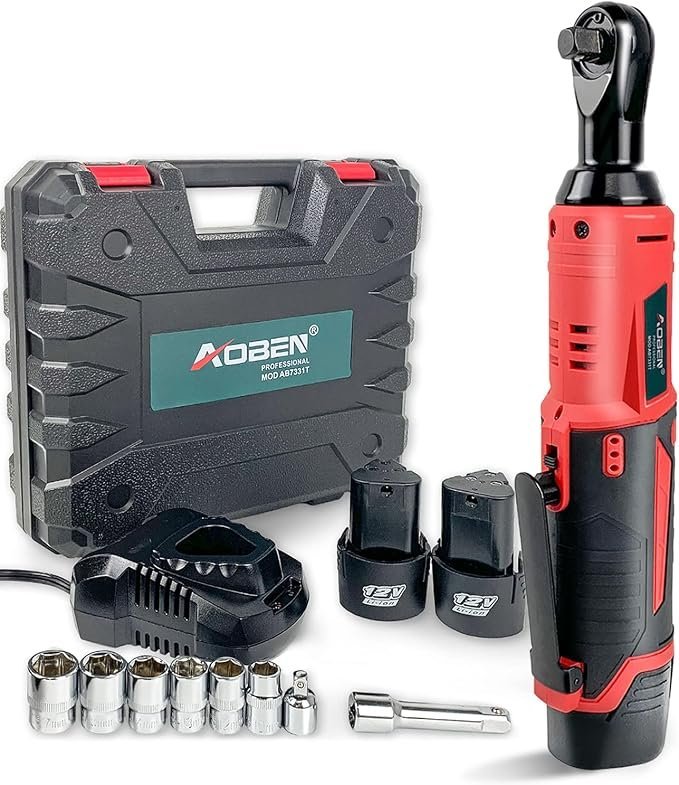
The AOBEN 3/8-inch 12V cordless electric ratchet wrench set is aimed at exactly that job, and it is packaged as a complete kit rather than a bare tool: the wrench, two 2,000mAh lithium-ion batteries, a charger, a set of sockets, an extension, and a carrying case. This review covers the features, the battery and maintenance side that buyers ask about most, and the safety rules that matter with any powered ratchet. Specifications come from the product listing; anything that could not be verified is clearly marked rather than invented, and nothing here is a hands-on test result.
Product Overview
The full product identity used here is the AOBEN Cordless Electric Ratchet Wrench Set, 3/8-inch drive, 12V, with two 2,000mAh lithium-ion batteries and charger. It is a compact, red-and-black 12V tool with a slim handle and a small drive head — the two features that decide whether a ratchet is usable under a dashboard or against a firewall. The head also works as a plain manual ratchet, so you can crack a fastener by hand and then let the motor take over.
The drive is 3/8-inch, which is the practical middle ground for a tool like this: it fits the socket sizes used on most brackets, covers, suspension hardware, and small engine bolts, and it is the size most people already own. The kit approach is the other half of the story. Two batteries means one can be charging while the other is on the tool, which is what turns a single-battery gadget into something you can actually finish a job with. Confirm the exact model number and accessory list on the live listing before publishing, because kit contents vary between AOBEN listings.
- DEWALT DCF510B 20V MAX XR cordless ratchet review
- Milwaukee M12 FUEL 3/8-inch high speed ratchet review
- Milwaukee 2457-21 vs M12 FUEL 3/8-inch ratchet comparison
- All power tool reviews on PetecGlobalMarket
Key Features
3/8-inch square drive
The most useful drive size for automotive and equipment work — it covers the fastener range you meet on covers, brackets, and accessories without going so large that the head becomes bulky.
12V motor
A 12V brushed motor keeps the tool light and small, which is the whole point of a cordless ratchet. It is built to spin fasteners after breakaway, not to break them free.
Two batteries included
The kit ships with two 2,000mAh lithium-ion packs, so a charging one does not stop the job.
Charger and case included
A dedicated charger and a molded carrying case make this a self-contained kit rather than a tool that needs supporting purchases.
Forward and reverse with variable trigger
Directional control plus trigger modulation means you can run a fastener down slowly and stop before it seats, instead of relying on feel alone.
Manual ratchet head
The head ratchets by hand, so you can break a stubborn fastener free with a bar or by hand and then switch to powered spin. That two-stage use is how a cordless ratchet is meant to be worked.
Compact head and slim body
Designed for confined spaces — engine bays, equipment cabinets, and anywhere a socket wrench cannot get a full swing.
Socket and accessory set
The kit photo shows sockets and a drive extension in the case, so you can work straight out of the box. Confirm the exact accessory list on the live listing.
Specifications
The table below reflects what the product listing states for this AOBEN kit. Torque and no-load-speed figures published by the seller were not independently verified for this draft, so no number is repeated here — check the current listing for the manufacturer’s own rating.
| Brand / product | AOBEN cordless electric ratchet wrench set |
|---|---|
| Model / SKU | Confirm the exact model number on the live product listing before publishing |
| Drive size | 3/8-inch square drive |
| Voltage | 12V DC |
| Motor | Brushed motor (12V class) |
| Power included | Two 2000mAh lithium-ion battery packs |
| Charger | Included in the kit |
| Controls | Variable-speed trigger with forward and reverse, plus a manual ratchet head for breaking fasteners free by hand |
| Maximum torque | AOBEN’s listing states a maximum torque figure. It was not independently verified for this draft, so no number is repeated here — check the live listing |
| No-load speed | Listed on the product page — not verified for this draft |
| Kit contents | Ratchet wrench, two batteries, charger, sockets, drive extension, and a carrying case as shown in the supplied kit image — confirm the exact accessory list on the listing |
| Body | Compact head and slim handle for confined spaces |
| Colorway | Red and black |
Performance and Practical Applications
A cordless ratchet changes a repair in a specific way: it removes the swing. Where a manual ratchet needs a clear arc to move a fastener, a powered ratchet turns it in place, so it works against a firewall, inside a wheel well, under a dash, and behind an engine accessory. That turns a ten-minute contortionist act into a two-minute job on covers, brackets, and trim panels.
The honest limitation is torque. A 12V ratchet in this class is a spinner, not a breaker. The workflow that works is: crack the fastener free by hand or with a breaker bar, then let the ratchet run it out. Tightening is the reverse — run it down with the tool, then finish by hand with a torque wrench to the manufacturer’s specification. Do not treat the powered ratchet as a torque-setting instrument; it is not, and no ratchet of this type is.
Within that framing the AOBEN kit covers a lot of ground for a home mechanic: interior fasteners, covers, heat shields, hose brackets, battery hold-downs, small engine work, and general assembly on equipment and furniture. It is also genuinely useful for repetitive fastening where the count of bolts is the real problem. It is not the tool for suspension components under load, engine mounts, or anything with a high torque figure — those need a proper impact wrench or a breaker bar.
Battery life is where buyers ask the most questions, and the honest answer is that it depends on the work. Two 2,000mAh 12V packs are a sensible pairing for a tool that draws in bursts: the ratchet spends most of its time turning rather than under load, so a pack lasts through a typical round of bracket and cover removal. Actual runtime depends on fastener size, how many are seized, and how much you use the light and the manual ratcheting. This review does not claim a measured runtime figure, because the listing does not publish a verifiable one.
Build Quality and Durability
The AOBEN ratchet is a 12V DIY-and-home-mechanic tool, and its build should be judged against that rather than against a professional 18V platform. The housing is reinforced composite with a rubberized grip, the head is metal where it counts, and the red-and-black finish is the usual trade-style layout. The compact head is the part that matters most: on a powered ratchet the head geometry decides your access, and a small head is what makes the tool worth carrying.
Where a tool like this lives or dies is the drive head and the internal gearing. A ratchet head that is dropped on concrete, used as a hammer, or asked to break loose rusted hardware will wear out regardless of brand. Used as intended — spin after breakaway, hand-tight before torque — the mechanism has a much easier life. The included case is more useful than it sounds, because a ratchet stored loose in a drawer is a ratchet with a damaged head.
No durability test, cycle count, or warranty-claim data is available for this draft, and the manufacturer’s warranty terms were not verified. Check the warranty statement on the live listing before quoting any coverage period.
Pros and Cons
- Pros: Complete kit — wrench, two 2,000mAh batteries, charger, sockets, extension, and case
- Pros: 3/8-inch drive matches the socket set most home mechanics already own
- Pros: Compact head and slim handle reach fasteners a manual ratchet cannot swing on
- Pros: Two batteries mean one can charge while the other works
- Pros: Manual ratcheting head lets you break fasteners free before using the motor
- Cons: A 12V ratchet is a spinner, not a breaker — it will not loosen seized or high-torque hardware on its own
- Cons: Brushed 12V motor rather than a brushless professional platform
- Cons: Published torque and no-load-speed figures were not verified for this draft
- Cons: Not the tool for torque-critical fasteners without a separate torque wrench
Maintenance Guide
A cordless ratchet needs very little maintenance, but the little it needs protects the two expensive parts — the head and the batteries. Remove the battery before cleaning or inspecting the tool.
- Cleaning the tool: wipe the housing and the rubberized grip with a dry or slightly damp cloth. Keep water, degreaser, and solvents out of the head, the trigger, and the battery contacts. Never immerse the tool.
- Drive head: after each job, wipe grease and grit off the square drive and the head. A dirty drive lets a socket sit at an angle, which rounds the drive and chews up sockets. A drop of light machine oil on the ratchet mechanism — as the manual directs — keeps it turning smoothly.
- Sockets and accessories: inspect sockets for cracks, rounded interiors, or a worn retaining ball before each use. A cracked socket under load is a hand injury waiting to happen. Keep the extension’s detent clean so it locks into the drive.
- Loose or damaged components: check the housing screws, the drive retaining clip, and the trigger for play. If the head skips under light load, or a socket wobbles on the drive, stop using the tool rather than working around it.
- Battery care: charge the supplied 2,000mAh packs with the supplied charger only. Do not leave packs on the charger indefinitely, do not store them fully discharged, and keep them out of direct sun and out of the cold. Never open, puncture, short, or attempt to repair a battery pack yourself — a damaged lithium-ion pack is a fire risk, not a repair project. Replace it with a compatible pack instead.
- Charger maintenance: keep the charger contacts clean and dry, check the cord for cuts or exposed wire, and unplug the charger when it is not in use. Do not use a charger that has been dropped, wet, or overheated.
- Storage: return the wrench, both batteries, the charger, and the sockets to the molded case. Store the kit indoors, away from moisture and dust, at a moderate temperature. Do not store the battery installed in the tool.
Safety Tips
- Remove the battery before changing sockets, inspecting the drive, cleaning the tool, or storing the kit. A powered ratchet that starts under your fingers is the most common way this tool hurts people.
- Do not break a fastener loose with the motor. Crack it free by hand or with a breaker bar. Pulling the trigger on a seized fastener strips the head, damages the gearing, and can spin the tool. The manufacturer’s listing and manual describe how the tool is meant to be used — follow them.
- Follow the manufacturer’s instructions and the vehicle or equipment service manual for final tightening and torque requirements. Do not assume this tool — or any powered ratchet — produces the torque you need. Run the fastener down with the tool, then finish with a calibrated torque wrench to the specified value.
- Use the correct socket size and a fully seated socket. A loose or wrong-sized socket rounds the fastener and slips under load.
- Wear eye protection. Rust, brake dust, and metal fragments come off fasteners, and a slipping socket sends them.
- Support the tool and the work. Do not brace the ratchet against a fragile component to resist reaction torque, and do not use it as a lever or a hammer.
- Keep the tool away from fuel lines, battery terminals, and any live electrical circuit, and disconnect the vehicle battery before working near wiring or the electrical system.
- Do not use the ratchet on fasteners that are under load or that hold a component in place mechanically. Loosen and support the load first.
- Let the tool stop before changing direction. Do not force the switch while the head is still turning.
- Work in a ventilated area where you are not breathing exhaust, brake dust, or solvent vapor.
Comparison Table
The table below compares this AOBEN kit with cordless ratchets from other brands and platforms. It is a fit-and-features comparison, not a torque ranking. Where a manufacturer’s torque or speed figure was not verified for this draft, the cell says so rather than repeating a number.
How the AOBEN 12V ratchet compares with other cordless ratchets
| Spec | AOBEN 12V 3/8-inch | Milwaukee M12 2457-20 | DEWALT DCF510B | ACDelco ARW1209 |
|---|---|---|---|---|
| Type | Cordless ratchet wrench | Cordless ratchet | Cordless ratchet | Cordless ratchet |
| Drive size | 3/8-inch | 3/8-inch | 3/8-inch | 3/8-inch |
| Voltage class | 12V | 12V (M12) | 20V MAX | 12V |
| Platform | AOBEN 12V | Milwaukee M12 | DEWALT 20V MAX | ACDelco 12V |
| Sold as | Kit with two batteries and charger | Tool only on typical listings | Tool only (DCF510B) | Kit with battery and charger |
| Batteries included | Two (2,000mAh) | No | No | Typically one |
| Carrying case | Included (per kit image) | No | No | Varies by listing |
| Stated max torque | Confirm on current AOBEN listing | Confirm on current Milwaukee listing | Confirm on current DEWALT listing | Confirm on current ACDelco listing |
| Best fit | DIY and home mechanics wanting a ready-to-use kit | Auto and HVAC pros on M12 | 20V MAX users | Budget garage work |
Comparison cells marked for confirmation were not invented. No prices or ratings are shown.
Who Should Buy It?
This kit suits home mechanics, DIY users, and automotive repair enthusiasts who work on their own cars, bikes, small engines, and equipment and who regularly end up in a space where a manual ratchet cannot swing. It is especially good value if you want to be able to work the moment the box arrives — two batteries, a charger, sockets, and a case means there is nothing else to buy. Anyone assembling equipment, furniture, or machinery with a lot of fasteners will also feel the benefit.
It is not the right tool if your work is dominated by high-torque fasteners — suspension hardware, engine mounts, or anything the service manual specifies at a high figure — because that is impact wrench territory. Nor is it the tool for critical torque applications without a separate torque wrench. And if you are already invested in a professional platform such as Milwaukee M12 or DEWALT 20V MAX, buying a ratchet on that platform may serve you better than adding a third battery system to the shop.
Frequently Asked Questions
Q.What is included in the AOBEN 12V cordless ratchet wrench set?
A.The kit is listed with the 3/8-inch ratchet wrench, two 2,000mAh 12V lithium-ion batteries, a charger, and — as shown in the supplied kit photo — sockets, a drive extension, and a carrying case. Confirm the exact accessory list on the live product listing.
Q.Is it 3/8-inch drive?
A.Yes. It uses a 3/8-inch square drive, which fits the socket sizes most home mechanics already own.
Q.Can it loosen tight or rusted bolts?
A.It is a spinner, not a breaker. Crack stubborn fasteners free by hand or with a breaker bar, then use the ratchet to run them out. Do not force it on seized hardware.
Q.Does it replace a torque wrench?
A.No. Never treat a powered ratchet as a torque-setting tool. Follow the manufacturer’s instructions and the service manual for final tightening and torque values, and finish with a calibrated torque wrench.
Q.How long do the two batteries last?
A.Runtime depends on fastener size, how many are seized, and how much the motor is under load. Two packs lets one charge while the other works. No verified runtime figure is published in the listing for this kit, so this review does not quote one.
Q.Can I use the ratchet by hand as well?
A.Yes. The head ratchets manually, which is the intended way to break a fastener free before switching to powered spin.
Q.What maintenance does it need?
A.Wipe it down, keep the drive head and sockets clean, check for loose or damaged parts, charge the batteries with the supplied charger, and store everything in the case with the battery removed.
Q.Can I replace the battery with a bigger pack?
A.Use only a compatible AOBEN pack of the same voltage, and charge it with the matching charger. Do not modify packs or use an unmatched charger.
Why Buy It?
The case for this AOBEN kit is completeness and access. It gives you a compact 3/8-inch powered ratchet for the places a hand ratchet cannot go, and it arrives ready to work — two batteries, a charger, sockets, an extension, and a case. For a home mechanic who is tired of losing knuckles on a bracket bolt, that is a concrete improvement in the job, and it removes the hand fatigue that slows down long fastener runs.
Final Verdict
The AOBEN 3/8-inch 12V cordless electric ratchet wrench set is a sensible buy for DIY users and home mechanics who want a powered ratchet for confined spaces without building out a professional battery platform. The 3/8-inch drive, compact head, manual ratcheting option, two 2,000mAh batteries, charger, sockets, and case together make it a genuinely useful kit rather than a novelty. Just be clear about what it is: a spinner for fasteners you have already broken free, not a torque tool and not an impact wrench. Crack the bolt by hand, run it out with the ratchet, finish with a torque wrench to the manufacturer’s specification, and remove the battery before every socket change or cleaning. Check the current listing for the seller’s own torque and speed ratings and the exact kit contents before you buy.
Ready to check current pricing?
As an Amazon Associate I earn from qualifying purchases.
Check Price on Amazon